Hospital clown Martin Ingleby: "Magic happens"
Martin Ingleby has worked as a hospital clown for 21 years and is one of Denmark's first of its kind. He was inspired by the biographical film about the doctor Patch Adams, who in the 1970s discovered that humour could help sick people. This led the American to found the health organisation "The Gesundheit! Institute, which uses play and laughter as part of treatment and has developed the hospital clown.
"When I saw Patch Adams, everything came together. I loved working with children, I danced, I juggled, I acted and played music. In other words, I had a lot of tools to become a hospital clown, I just had to figure out how," says Martin Ingleby.
Soon after, he met Birgit Bang Mogensen, one of Denmark's earliest hospital clowns, and became an apprentice on her first clown team. Martin Ingleby graduated in 2002 as a hospital clown and has been working with his red nose in the white corridors ever since.
Magical relationship through improvisation
Although Martin Ingleby's artistic skills were a major driving force in becoming a hospital clown, he considers them just part of the toolbox.
"The clown is an imaginative friend who takes the child's mind off their illness. I'm not part of the hospital or the family. I'm just a friend. So it doesn't really matter if you can do magic or play music."
Martin Ingleby emphasises artistic improvisation as a key element.
"For me, it works best to visit a room without a plan. That way I know that I'm 100% present in the moment and act on my intuition when meeting the child. Our most important task is the combination of empathy and presence, and this is best achieved through improvisation."
In professional language, this technique is called the clown method. Together with the individual character of the clown characters, this special approach forms the basis for the hospital clown's long work in Danish hospitals.
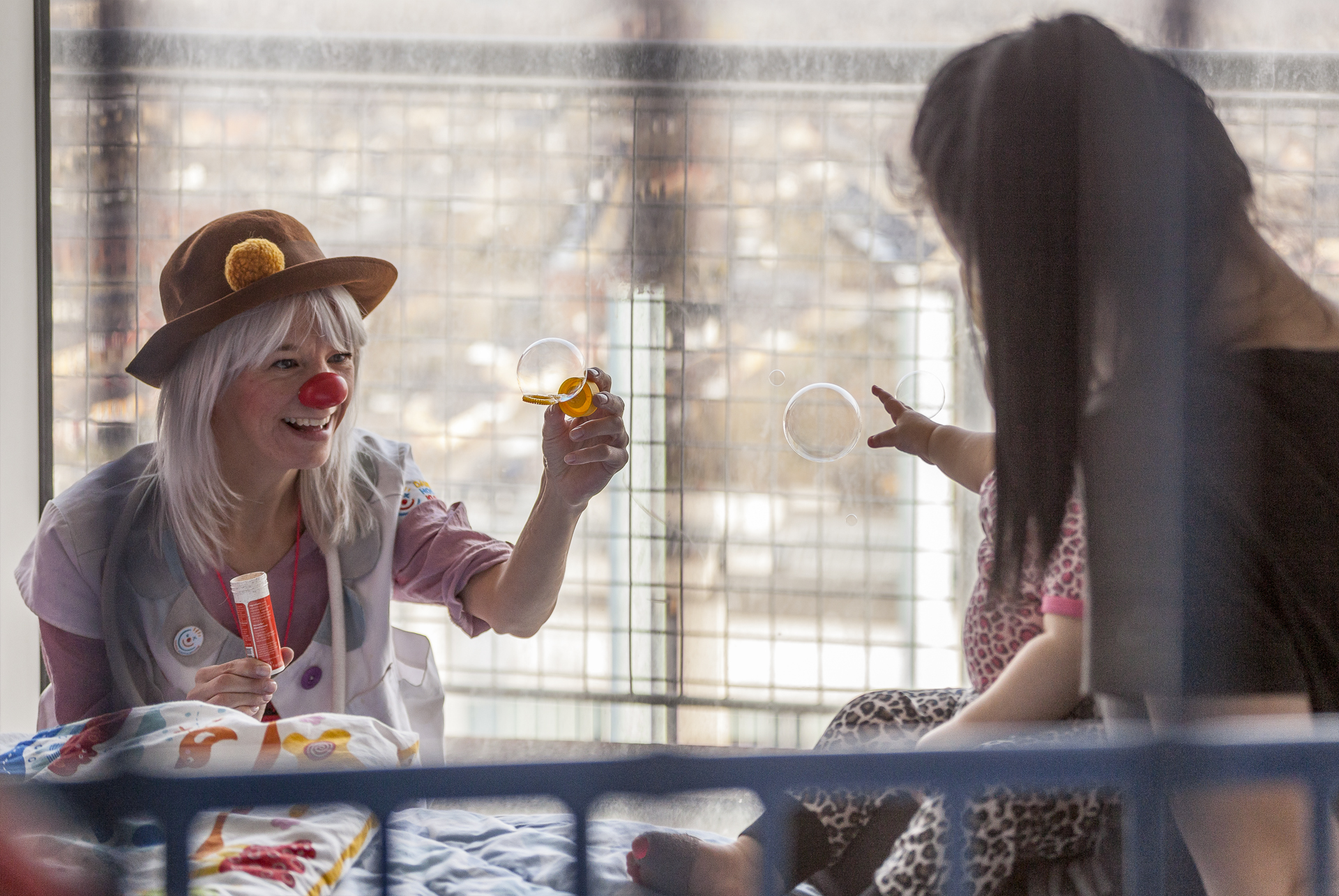
"Magic happens. It's nothing short of magical how the red nose creates both a unique relationship and a safe space for children in a vulnerable situation. Of course, the artistic aspect helps to distract the child, but it's the relationship that is the main thing," says Martin Ingleby, who therefore thinks he has the best job in the world.
When asked whether working as a hospital clown isn't also hard work, Martin Ingleby has an admirable principle.
"It's about seeing the glass half full and not half empty. Instead of focusing on how bad the child is feeling, I emphasise that my visit has added something positive and I've made it a bit more fun to be them," says Martin Ingleby and explains that he also uses this approach in the wards.
"I always find the positive in a situation. For example, if a child has been given crutches, we talk about how cool the crutches are. Or if a little girl has broken her hand, we talk about how great it is that she can now make beads with her left hand. It helps with the mood."
For example, if the child has crutches, we talk about how cool the crutches are."
"It never gets boring"
Not only does the work make a difference, but the days are varied and unpredictable. You never know what you'll encounter," says Martin Ingleby.
"We almost never know what we're going to walk into when we knock on a door. Who is the child, what are they interested in, and how are they feeling at that exact moment? No two times are the same."
And no two children are the same," says Martin Inglebly. The clown figure stimulates the child's senses and imagination, which together create the magic in the classrooms.
"A new child means a new unique relationship because we create the moment together. That's why working as a hospital clown is still exciting after 21 years. It never gets boring."
The job as a hospital clown is also a good match with his work as an artist, he emphasises.
"I work as a clown at the hospital during the day, so I have the opportunity to do other gigs in the evenings and weekends."
Danish Hospital Clowns is looking for clown apprentices about once a year. If you want to supplement and develop your artistic work while helping sick people - especially sick children - through humour and laughter, this could be for you. Read more about it here.